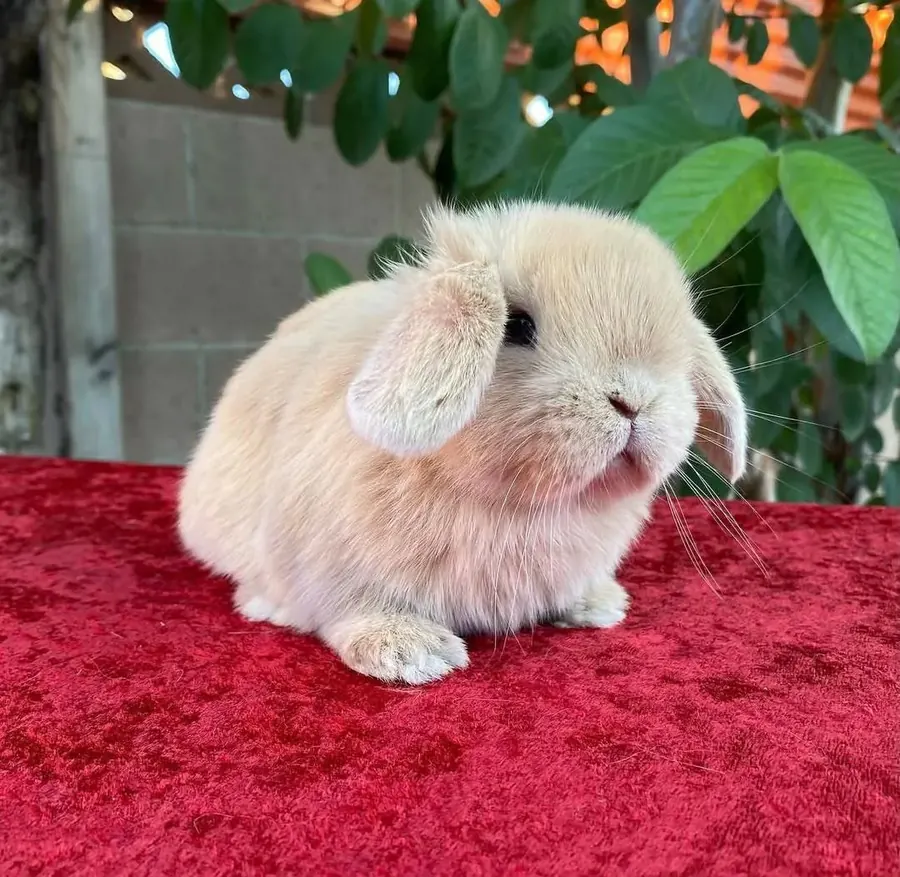
Baby Holland Lop Bunnies: Newborn Holland Lop Growth to 8 Weeks
A baby Holland Lop is born hairless and blind after a pregnancy of about 31 days, opens its eyes around day 10, leaves the nest at about 3 weeks and is ready for a new home at 8 weeks. The ears can drop anywhere from a few weeks old to several months, and that range is normal.
Baby Holland Lop Development, Week by Week
Every kit in our barn is checked and handled daily from the day it is born. These are the milestones we see in a typical Holland Lop litter. Individual kits run a few days ahead or behind, and that is normal.
Age
Typical weight
What is happening
Birth (day 0)
1.5 to 2 oz
Hairless, eyes and ears sealed. The doe nurses once or twice a day, usually at night, for only a few minutes.
Week 1
3 to 5 oz
Fine fur appears by day 4 or 5. Color and markings become visible. Bellies should look round and tight after feeding.
Week 2
5 to 7 oz
Eyes open around day 10, ears unseal soon after. Kits start to wriggle and hop inside the nest box.
Week 3
7 to 10 oz
Kits leave the nest, often popping out at day 16 to 20. They start nibbling hay and the doe's pellets.
Week 4
9 to 12 oz
Eating more solids each day and drinking water. Litter habits begin. Some ears start to droop.
Weeks 5 and 6
10 oz to 1 lb 2 oz
Nursing tapers off. Gut flora is settling, so diet stays exactly the same. Teeth and ears go through growth spurts.
Week 7
12 oz to 1 lb 6 oz
Fully weaned. Personalities show clearly: the bold explorer, the lap sitter, the shy one.
Week 8
1 lb to 1 lb 12 oz
Ready to go home. Litter trained, eating hay and pellets on its own, ears dropped or dropping.
Newborn Holland Lops: Pregnancy and the First Days
Holland Lop gestation is about 31 days, with a normal range of roughly 28 to 33. In the last week we add a nest box packed with hay, and the doe finishes it by pulling fur from her chest and belly, sometimes only hours before she kindles. Litters are small, typically 2 to 5 kits.
Newborn Holland Lops look nothing like the bunnies in the photos. They are pink, wrinkled, about 3 to 4 inches long and blind. People are often alarmed that the doe seems to ignore them. That is how rabbits work: she stays away to avoid drawing predators to the nest and returns to feed once or twice in 24 hours. A newborn with a round, full belly and skin that springs back when gently lifted is being fed.
The Dwarf Gene and Peanuts in Holland Lop Litters
Holland Lops are a dwarf breed, and dwarf genetics come with one hard fact. A kit that inherits two copies of the dwarf gene, called a peanut, is born very small with an oversized head and does not survive beyond a few days. It is not caused by anything the owner or breeder did, and it is part of why Holland Lop litters can lose a kit early even in a careful barn. Kits that inherit one copy are the true dwarfs, and those with none, called false dwarfs, grow a little larger and are often excellent brood does.
When Do Holland Lop Ears Drop?
This is the question we get most from families watching our litters. Holland Lop kits are born with ears that stand up or stick out sideways. As the head grows and the ear cartilage gets heavier, the ears fold down at the crown. Most of our kits have both ears down somewhere between 6 and 12 weeks.
That said, the range is wide. Some kits have lopped ears by 4 weeks. Others carry one ear up, sometimes called an airplane ear or a half lop, until 3 to 5 months, and it is common for ears that had dropped to lift again for a few days during teething around 3 to 4 months. A thick, well defined crown is the best sign that the ears will settle. A kit whose ears are still up at 8 weeks can be a perfect pet and may still drop; we tell you honestly where each kit stands.
What an 8 Week Old Holland Lop Should Look Like
Eight weeks is the minimum age our kits go home, and we hold some longer if they need it. A healthy 8 week old Holland Lop is bright eyed, curious, and plump in the hindquarters. Here is what we check, and what you should check with any breeder:
Weight in the 1 lb to 1 lb 12 oz range and gaining week over week
A clean, dry vent with no staining or pasted droppings
Front teeth that meet correctly, with the top incisors just over the bottom ones
Clear eyes and a dry nose, no sneezing
Round, firm droppings in the litter box
Eating hay steadily without needing the doe
The biggest mistake new owners make in the first week is changing the food. A baby Holland Lop's gut is still adjusting, and a sudden switch in pellets or a handful of greens is the most common trigger for diarrhea at this age. Keep the kit on what it was raised on (we send transition feed home with it) and hold off on greens until about 12 weeks. Our Holland Lop diet guide has the full schedule for introducing new foods.
Holland Lop Baby Bunny Names
Many families name their kit before pickup, usually based on color. Biscuit and Mocha go to chocolates, Pepper and Onyx to blacks, Marmalade to oranges. If you are stuck, wait a week: personality usually names the rabbit for you.
Baby Holland Lop Litters: Current and Upcoming
We keep a small herd and plan only a few litters each season so every kit gets daily handling. That means our baby Holland Lops are often spoken for before they reach 8 weeks. Kits that are available now, with their colors, grades and go home dates, are listed on our Holland Lop bunnies for sale page.
For upcoming litters, the waitlist is the way in. Contact us to join the waitlist and tell us what you are hoping for: color, sex, pet or show quality. Use the table above to follow along: by the time a litter reaches week 3, colors and markings are clear enough to talk about which kit might suit you. When your kit is ready, a deposit holds it, pickup in Texas is by appointment, and flight delivery to your nearest major airport is quoted per trip based on the airport and airfare.
Questions buyers ask
How long are holland lops pregnant?
About 31 days. Holland Lop does usually kindle between day 28 and day 33 after breeding, with most litters arriving on day 30 to 32. We add the nest box around day 27 or 28 so the doe can build her nest with hay and pulled fur. A doe that has not kindled by day 33 needs a call to the vet.
When do holland lop ears drop?
Most Holland Lop ears drop fully between 6 and 12 weeks, but some kits have lopped ears from about 4 weeks and others carry one ear up until 4 or 5 months. Ears often lift again for a while during growth spurts and teething. A crown that is well defined and thick usually means the ears will drop eventually.
How big is a newborn holland lop?
A newborn Holland Lop usually weighs about 1.5 to 2 oz, roughly the weight of a large egg, and is around 3 to 4 inches long. It is born hairless, with eyes and ears sealed shut. Small litters often produce bigger kits, and kits in large litters can start closer to 1 oz.
What does an 8 week old holland lop weigh?
Most 8 week old Holland Lops weigh between 1 lb and 1 lb 12 oz. Kits from smaller lines can be closer to 14 oz, and that is fine if they are eating well and gaining steadily. At this age they should be fully weaned onto hay, pellets and water, with no milk from the doe.
How many babies do holland lops have?
Holland Lop litters are small, usually 2 to 5 kits, with 3 or 4 being typical. First litters are often smaller. Dwarf breeds carry a risk of peanuts, kits that inherit two copies of the dwarf gene and do not survive past a few days, so a born count is not always the final count.
Found your Holland Lop?
Fill out a short application so we can make sure it is a good match. We reply within 24 hours.