Holland Lop Care and Holland Lop Rabbit Cage Setup
Holland Lop care comes down to four things: unlimited grass hay, a pen big enough to hop in (we recommend at least 48 by 48 inches), a room kept between 60 and 75 F, and a few hours of daily time out of the enclosure. Get those right and most other problems never start.
Holland Lop Bunny Care: What a Bunny Needs Every Day
Every morning in our barn starts the same way: hay first, then water, then a look at every rabbit and every litter box. That routine works just as well in a house, and it is most of the answer when buyers ask how to care for Holland Lop bunnies. Here is the daily list we give our buyers.
Hay: a fresh pile of grass hay about the size of your rabbit's body, morning and evening. Toss the old hay that has been soiled or sat on.
Water: a heavy ceramic bowl, rinsed and refilled daily. A 3 lb rabbit drinks roughly half a cup to a cup a day, more in warm weather.
Litter box: scoop wet spots daily so the box never smells.
Health check: did your rabbit eat its pellets right away? Are there plenty of round droppings? Is it moving normally?
Exercise: at least 3 to 4 hours outside the pen in a rabbit proofed room.
That health check is the most important line on the list. A Holland Lop that ignores breakfast is telling you something, and rabbits go downhill fast. Twelve hours without eating or passing droppings means a call to a rabbit savvy vet, not a wait and see.
Holland Lop Bunny Cage Size and Setup
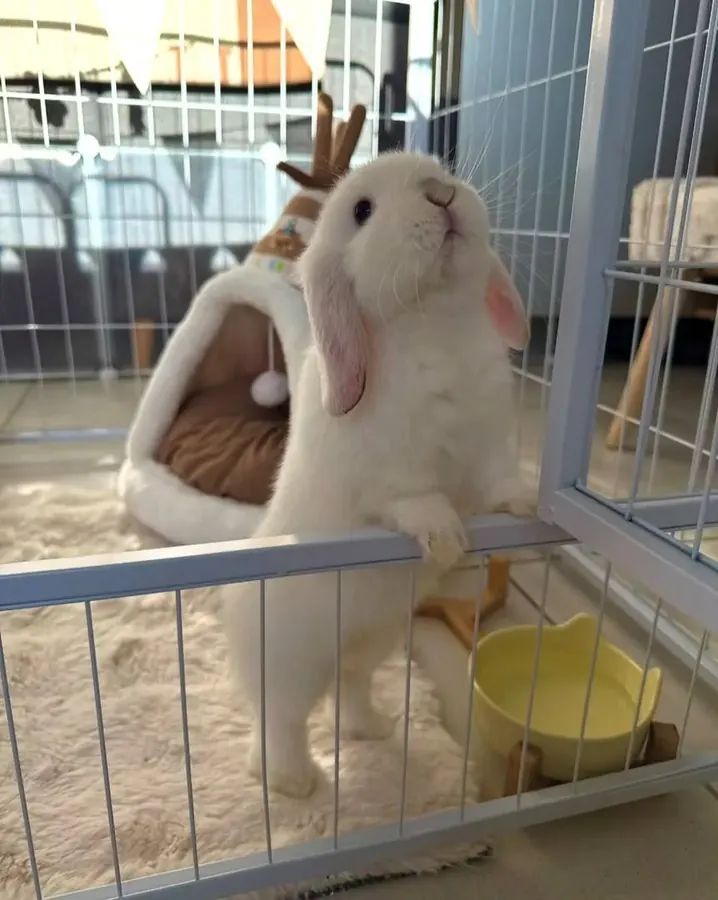
Most pet store cages sold for rabbits are too small for a Holland Lop. A rabbit should be able to take three or four hops in a row, lie fully stretched out and stand on its hind legs without its ears touching the top. For a 3 lb Holland Lop, that translates to these numbers.
Setup
Floor size
Height
Notes
Cage as a home base only
36 by 24 inches minimum
18 inches or more
Must be paired with a pen or free roam time
Exercise pen (our pick)
48 by 48 inches
30 to 36 inch panels
16 square feet, enough for one rabbit
Pen for a bonded pair
48 by 72 inches
30 to 36 inch panels
24 square feet
Free roam room
Whole room
Not applicable
Rabbit proof cords, baseboards and furniture legs
Our recommendation for most homes is a metal exercise pen of 8 panels, each about 24 inches wide and 30 to 36 inches tall, set up as a 48 by 48 inch square. It costs less than most large cages, folds flat and can be expanded later. A Holland Lop can jump, so if yours clears 30 inches, go to 36.
Holland Lop enclosure layout
Think of the pen in zones. Rabbits like to eat and toilet at the same time, so put those together and keep the resting area away from them.
Toilet and hay corner: a litter box about 16 by 12 inches with sides 4 to 6 inches tall, with a hay rack or simply a big pile of hay over one end of the box.
Water: a heavy ceramic bowl near the hay but not inside the box, where it would get soiled.
Hide: a cardboard or untreated wood box about 14 by 10 inches and 10 inches tall, with two doorways so the rabbit never feels trapped.
Open floor: the rest of the space stays clear for hopping and flopping.
Chew and play: one or two items, such as a willow ball or a cardboard tube stuffed with hay, rotated weekly.
Bedding and flooring
Do not use a wire floor. Holland Lops have small feet with no pads, and wire causes sore hocks. Cover hard floors with a washable cotton rug, a fleece blanket or a low pile runner so the rabbit has grip. In the litter box, use paper based pellets, aspen shavings or pelleted wood litter made for small animals. Avoid cedar shavings and untreated pine shavings, whose oils irritate a rabbit's airways and liver, and skip clumping cat litter, which causes blockages if eaten.
Holland Lops have a short, rollback coat that needs little work most weeks. Brush once a week with a soft brush or rubber glove, and every day during a molt. A molt often shows as a line of new coat moving across the body, or tufts coming out in your hand. Trim nails every 6 to 8 weeks, cutting just before the pink quick on light nails. Never bathe a rabbit in water: it chills them and can send them into shock. Spot clean a dirty rear with a damp cloth instead.
Check inside the ears once a month. Lop ears hang down and trap more wax and moisture than upright ears, so look for brown crust, smell or head shaking.
Caring for Holland Lops in Hot and Cold Weather
Keep the pen in a room your family actually uses, out of direct sun and away from heating vents and drafty doors. The best range is 60 to 75 F. Above 80 F, add a frozen water bottle wrapped in a towel and a ceramic tile to lie on, and above 85 F treat it as an emergency. Cold is easier: an indoor Holland Lop at 60 F is comfortable, and a hide box with a folded fleece inside is plenty in winter. Keep the pen off cold tile near an outside door, where drafts sit at floor level. We raise our rabbits in a climate-controlled barn for exactly this reason. Household noise is fine: our kits grow up hearing everyday sounds, so a TV or vacuum in the next room will not frighten them for long.
Caring for a Holland Lop: Vet Visits and Spaying
Find a vet who treats rabbits before you bring your bunny home. Plan a wellness visit in the first month, then yearly. Spay does at about 5 to 6 months and neuter bucks at about 4 to 5 months. It lowers the risk of uterine cancer in does, reduces spraying and territorial behavior and makes litter habits much more reliable. Warning signs that cannot wait: no eating or droppings for 12 hours, a head tilt, labored breathing, diarrhea or a hunched posture with teeth grinding.
Good daily care is also what decides how long your rabbit lives. Our guide to Holland Lop lifespan covers the long term side.
How to Care for Holland Lop Rabbits: Mistakes to Avoid
Knowing how to care for a Holland Lop rabbit is partly knowing what not to do. The one we see most is a cage that is too small with no exercise time, which produces a bored rabbit that chews its bars and gains weight. The second is a sudden diet change. Every bunny we send home comes with transition feed, the food it was raised on, a care sheet and a quick bunny care lesson at pickup, and we ask buyers to mix in any new food over 7 to 10 days. The third is unsupervised handling by young children, which we cover in our page on whether Holland Lops are good pets for families. If a question comes up later, our buyers can text or call us for the life of the rabbit.
Questions buyers ask
Are holland lop bunnies easy to take care of
Holland Lop bunnies are easy to care for day to day but not low maintenance. Expect about 20 minutes of chores each day: refilling hay, changing water, spot cleaning the litter box and a quick health check. Add a weekly deep clean, nail trims every 6 to 8 weeks and several hours of supervised exercise time.
Do holland lops shed a lot
Holland Lops shed moderately most of the year and heavily two to four times a year during a molt, which can last two to three weeks. During a molt, brush every day with a soft slicker or rubber grooming glove. Rabbits cannot vomit, so swallowed fur has to pass through the gut, and extra hay helps it move.
What temperature is too cold for a holland lop
A healthy adult Holland Lop handles cool rooms better than hot ones, and 55 to 60 F is comfortable with good bedding. Below about 40 F a small rabbit housed outdoors needs serious shelter, and young kits need warmer temperatures than adults. Heat is the bigger danger: keep the room under 80 F.
How big should a holland lop rabbit cage be
A Holland Lop rabbit cage should be at least 36 by 24 inches if it is only a sleeping base, paired with an exercise pen. If the enclosure is the rabbit's main space, aim for at least 48 by 48 inches of floor area with sides 30 to 36 inches high so the rabbit can hop, stretch out flat and stand up.
Can a holland lop live outside
We recommend keeping Holland Lops indoors. Small rabbits overheat quickly above 80 F, are stressed by predators at night even behind wire, and are harder to monitor for illness outside. If you must house one outdoors, it needs a predator proof, shaded, insulated hutch and a daily check, but indoor living is safer.
Found your Holland Lop?
Fill out a short application so we can make sure it is a good match. We reply within 24 hours.