

Snow
$350- Sex
- Doe / Female
- Age
- About 10 to 12 weeks
- Ready
- Now
- Color
- Ruby-eyed white
- Quality
- Pet
Check the eyes first. A healthy white Holland Lop bunny has bright, dry eyes: an even sky blue on a blue eyed white (BEW), pink to ruby on a ruby eyed white (REW) or pointed white. After that, keeping a white coat clean is mostly about housing, because urine, damp bedding and tear tracks show on white fur weeks before they would on any other color.

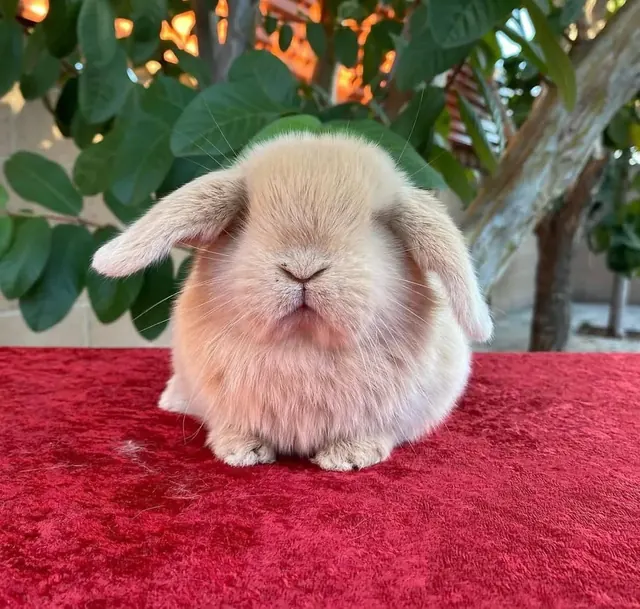


Nothing available in this color right now. Join the waitlist and we will tell you when the next litter arrives. Join the waitlist.
When our litters include blue eyed white, ruby eyed white or pointed white kits, we handle them daily and grade each one at 8 weeks against the ARBA standard. If you searched for a BEW Holland Lop for sale, a blue eyed white Holland Lop for sale, a blue eyed white Holland Lop bunny for sale or blue eyed white Holland Lop rabbits for sale, the grid below shows what is listed now. Pet quality whites start at $300; show quality whites start at $400.
No white kit goes home before 8 weeks, and each one leaves with its grade, a birth certificate and transition feed of its usual food, collected here in Texas or flown to you in the cabin with one of us. We are a small Holland Lop breeder, so if no whites are showing, join the waitlist and hear before the next one is posted.
White fur is honest. A colored kit can sit in a damp corner for a week and look fine in photos; a white one shows it on its hocks by the second day. We see that as a benefit for buyers. On a white Holland Lop, most of what a health check looks for is visible at arm's length, if you know where to look.
Bring this list to pickup, or ask for these photos in daylight before a flight delivery. It takes about five minutes, and we would rather you go through it with us than find something at home.
The two solid whites look identical from behind and are completely different genetically. A blue eyed white Holland Lop has two copies of the Vienna gene (vv). The Vienna gene keeps pigment cells out of the coat and most of the iris, which is why you get a white Holland Lop with blue eyes, but the pupil still looks dark, a sign that pigment remains at the back of the eye. In our barn BEWs handle light the same way colored rabbits do.
An REW Holland Lop is an albino (cc at the C locus). No pigment forms anywhere, eyes included. What you see as pink or ruby is blood behind clear tissue. With nothing to absorb stray light, an REW squints in glare and is happier out of direct sun. They see well enough to run, binky and find every snack bag in the house; the issue is comfort, not blindness. We place REW pens away from the barn's brightest windows, and we suggest the same for owners: no pen under a skylight, no afternoon sun through a south window, and a covered hide box where the rabbit can step out of the light.

Urine stains are the complaint we hear most from owners of white rabbits, and they nearly always come from the setup, not the rabbit. A Holland Lop that sits in a soaked corner of its litter box picks up yellow on the hocks and the underside of the tail within days. Once the fur stains, it rarely comes fully clean; it grows out at the next molt.
Flooring outside the box matters too. A rug or fleece over hard flooring stays dry and gives the feet grip. Wire floors and damp towels are both hard on white hocks. Our Holland Lop care and setup guide covers pen sizes and layout in more detail.
Full baths frighten rabbits, chill them and leave a dense coat damp at the skin for hours. For a stain, dampen a cloth with lukewarm water, work it through the patch and dry the spot completely with a towel and a fine comb. A sprinkle of plain cornstarch combed through the hocks and brushed back out lifts light soiling. Never use talc or human shampoo.
Every BEW sits on top of a hidden color, and every BEW passes one Vienna gene to every kit. Breed a BEW to a rabbit with no Vienna gene and the whole litter is colored, but each kit carries Vienna (Vv). Many of those carriers show it: a white snip on the nose, a white star on the forehead, white toes, or blue streaks in an otherwise brown eye. Those are Vienna marked kits, often listed as VM. Some carriers show no marks at all, which is why a pedigree with a BEW anywhere in it is worth reading closely.
Vienna marks are a disqualification on the show table and have no effect on health or temperament. A VM kit makes a perfectly good pet, and a marked kit often looks striking. Do not confuse them with brokens: a grey and white Holland Lop or an orange and white one is almost always a broken, a different gene that produces large white patches. Our broken Holland Lop guide explains those patterns.
A pointed white Holland Lop carries the Himalayan allele (c^h), which only makes pigment where skin runs cooler: nose, ears, feet and tail. Kits are born white, and the points tint in over the first several weeks. Because pigment is set as each hair grows, the points an adult grows in a cold month come in darker, and a summer coat can look smudgy and light. Owners who keep a pointed white in a cool room are often surprised by a near black nose after the first winter. The same temperature effect runs through the sable family, and our sable point Holland Lop page charts how far it goes.
When we list a BEW, REW or pointed white, it appears in the grid on this page; kits in other colors are gathered on the main availability page.
Not in any way that limits a pet. An REW finds its litter box, hay and people like any other Holland Lop. Because the iris and the back of the eye carry no pigment, more light scatters inside the eye, so REWs squint in glare and are less comfortable in strong sun. Keep the pen away from skylights and sunny windows and the eyes stay comfortable.
Spot clean, never bathe. Dampen a cloth with plain lukewarm water, work it through the stained fur on the hocks or belly, then towel and comb the area until it is completely dry. Old yellow staining often will not lift; it grows out with the next molt. The real fix is dry flooring and a litter box changed often enough that the rabbit never sits in wet bedding.
No. Healthy eyes are dry, with no crust in the corner and no damp track down the cheek. White fur just makes discharge easier to see. A weepy eye in a short faced breed like the Holland Lop can come from a blocked tear duct, dust, or a tooth root pressing on the duct. Have a rabbit savvy vet look at any eye that stays wet for more than a day.
Yes. Each Vienna marked parent carries one Vienna gene, so on average one kit in four inherits a copy from both parents and is a blue eyed white. About half the litter will be Vienna marked like the parents, and about one in four will carry no Vienna gene at all. Litters are small, so any single litter can land differently from those averages.
Fill out a short application so we can make sure it is a good match. We reply within 24 hours.