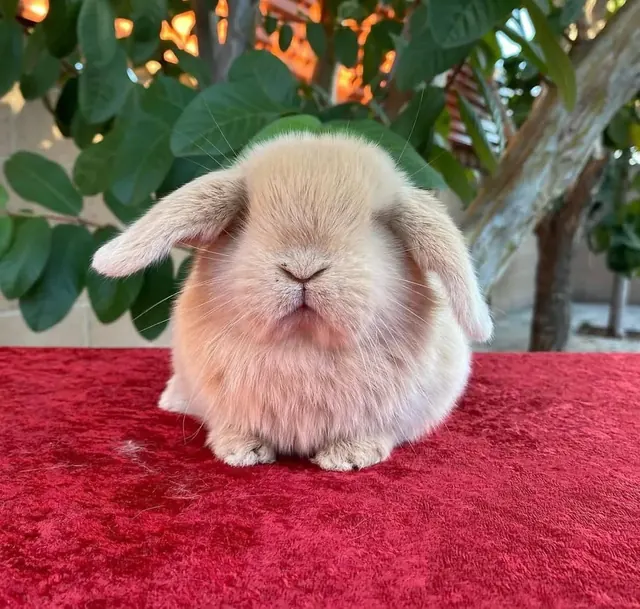
Black Tort Holland Lop and Blue Tort Holland Lop Bunnies
Tort Holland Lop kits change more between birth and 16 weeks than almost any other color, so we grade a black tort or blue tort at 8 weeks mostly on head, crown and body, and only partly on shading. The muddy, smoky baby coat clears during the first molt, and the orange saddle you hoped for usually arrives after go-home day.
Each tort we list was born here, handled daily, then graded at 8 weeks once we have checked its ear shading in daylight. A black tort Holland Lop for sale from us travels with a birth certificate, transition feed and a care sheet, healthy at the time of sale. Expect pet quality from $300 and show prospects from $400.
Hoping for a blue tort Holland Lop for sale instead? Blue torts only appear when both parents carry dilute, so the grid below is the honest answer on what is open today. No kit leaves before 8 weeks. Collect yours in Texas on an agreed day, or we carry your tort onboard, in the cabin, to the big airport closest to you. Nothing listed? Join the waitlist and name the shade you want. A Holland Lop breeder with a small herd would rather match you to the right tort than rush one.
Most tort buyers fall for a photo of an adult with a bright orange saddle and inky ears. Then they see a 5 week old kit in our nest box, smoky from nose to flank, and wonder if they are looking at the same color. They are. The trick is knowing what each week should look like, so you can tell normal baby shading from a fault that will stay.
How a Black Tort Holland Lop Develops Week by Week
This is the timeline we work from in our barn for both black torts and blue torts. Ages are approximate; some litters run a week ahead or behind, and the molt can start earlier in warm months.
Age
Coat and shading
Eye color
What we watch for
Birth to day 3
Bare pink to pale gray skin, slightly darker on ears, nose, feet and tail
Eyes sealed
Light skin with darker points tells us tort from a charcoal skinned self black. Blue torts look paler again.
Week 1
Short fawn fuzz with gray tipping on the points
Eyes sealed
White patches on the skin mean a broken tort. A white toe here hints at Vienna.
Week 2
Fuller coat, dull tan body, dark ears and muzzle
Eyes open around day 10, all a cloudy blue-gray
We check the eyes are clear and both open evenly. Too early to read eye color.
Weeks 3 to 4
Shading spreads over the face, cheeks and lower sides; body looks muddy
Black torts darken toward brown; blue torts stay blue-gray
Eye color now sorts black tort from blue tort. Heavy face shading here is normal.
Weeks 5 to 6
Baby coat at its dullest, smoke on flanks, sometimes along the spine
Settled
We start looking at head width, crown and the depth of the hindquarter.
Week 8
Junior molt often starting at the head and neck; brighter orange appears in patches
Settled
Grading day: pet, show or brood. Ear shading checked in daylight on both sides.
Weeks 10 to 12
Molt lines move down the body; new orange on shoulders, old dull coat on the rump
Settled
A patchy two-tone look is normal and does not mean the color is wrong.
Weeks 14 to 16
Shading tightens to ears, mask, feet, tail and lower flanks; saddle clears
Settled
Smut that stays across the back after this point is likely to stay for good.
After 16 weeks the coat keeps improving. The sharpest tort contrast usually shows after the senior molt somewhere between 6 and 8 months, when the rabbit is near its adult weight of about 3 lbs 8 oz to 4 lbs.
Blue Tort Holland Lop Kits Beside Black Torts in the Nest
Both come from the same two recessive genes, non-agouti (aa) and non-extension (ee). A blue tort Holland Lop adds a pair of dilute genes (dd), which softens every pigment in the coat. In practice that gives us three ways to tell them apart before 4 weeks.
Spotting a Holland Lop blue tort before 4 weeks
Skin tone at birth. Blue tort kits are the palest in a mixed litter, a faint gray on the points instead of a smoky charcoal.
Coat tone at 2 to 3 weeks. A black tort reads tan with brown-black points; a blue tort reads beige with pewter points.
Eyes at 3 to 4 weeks. Brown on the black tort, blue-gray on the blue tort. This is the most reliable of the three.
Buyers sometimes worry that a blue tort Holland Lop looks washed out at 6 weeks. It is supposed to be a gentler color, cream to fawn with slate shading, and it keeps that softer look as an adult. If you want punchy contrast, choose a black tort.
Grading a Tort Holland Lop Kit at 8 Weeks: Pet or Show
When we grade a tort at 8 weeks, color is the last thing we score, not the first. The coat is mid-change, and a kit that looks smutty now can clear beautifully by 16 weeks. Type does not change that way. A narrow head at 8 weeks is a narrow head at 8 months.
What we grade first: head, crown and body
We set the kit on a table and look from above and the side. We want a short, deep body with a wide, rounded hindquarter, a bold head set close to the shoulders, and a crown you can feel as a firm ridge behind the ears. Ears should be thick and hang close to the cheeks. A tort that hits those marks is a show prospect even if its saddle is still murky.
Tortoise Holland Lop shading faults that matter
Some color problems are worth noting at 8 weeks because they rarely improve. One ear clearly darker than the other in daylight. White toenails, a white snip on the nose or a white forehead spot, which point to Vienna and disqualify the rabbit on the show table. Shading that runs up into the eye circles as a solid band instead of a soft gradient. We note those on the grading sheet, and a kit with one of them goes to pet quality.
Faults that do not matter for a pet
Uneven shading, a smoky back and a slightly pale saddle are cosmetic. They have no effect on health, size or personality, and a pet quality tort from $300 is the same rabbit to live with as a show quality tort from $400.
Broken Tort Holland Lop, Chocolate Tort and Fuzzy Tort Kits
Holland Lop broken tort kits
A broken tort follows the same week by week timeline inside its colored patches, though the white makes the shaded ears stand out sooner. A broken black tort Holland Lop shows near black ear shading against white by about 3 weeks; a broken blue tort Holland Lop takes a little longer because its slate points are softer. Both are shown in the Broken group.
Chocolate tort Holland Lop and lilac tort
Chocolate torts look warmer at every stage, with milk chocolate points and brown eyes, and lilac torts are the palest of all, with dove gray points and blue-gray eyes. Both need the chocolate gene from each parent, so they turn up less often than black torts.
Fuzzy tort kits
Fuzzy torts molt on the same schedule, but the long coat hides the molt line, so we part the fur to check progress. Our baby Holland Lop growth guide covers the rest of what changes in those first weeks, and the full Holland Lop color chart shows where tort sits among the shaded colors.
Questions buyers ask
What does a 1 day old tort holland lop look like
A day old tort is nearly hairless, with pink to pale gray skin that is a shade darker on the ears, nose, feet and tail. Next to a self black littermate, whose skin is dark charcoal all over, the tort looks almost bare. That light skin with darker points is our first sign of a tort, and the fur that grows in over the next week confirms it.
Black tort or blue tort holland lop, which is better for a first rabbit
Neither is better, since color has no link to temperament or health. Pick on looks and on the kit itself. A black tort has stronger contrast, orange against near black points. A blue tort is softer, a creamy fawn with slate gray shading and blue-gray eyes. Both need the same diet, housing and handling, and both carry the same show standard for type.
Is a broken tort holland lop shown as a tort
No. A broken tort carries one copy of the broken gene, so it is shown in the Broken group, not the Shaded group where solid torts compete. Its colored patches are still judged as tort: orange with dark shaded ears and a shaded nose marking. Broken black tort and broken blue tort kits often show their shading earlier because the white makes the points easier to see.
What colors do two tort holland lops produce
Two torts produce tort kits, because both genes behind tort are recessive and each tort parent can only pass those copies on. You may still see blue torts, chocolate torts or lilac torts if both parents carry dilute or chocolate, and broken torts if one parent is broken. A hidden recessive such as sable or ruby eyed white can also appear if both parents carry it.
Can a fuzzy tort holland lop be shown
No. A fuzzy carries two copies of the wool gene, and a wool coat disqualifies a Holland Lop under the ARBA standard. A fuzzy tort makes a lovely pet, though its long coat blurs the shading so the points look softer. It needs brushing two to three times a week, and daily during a molt, to prevent mats and swallowed fur.
Found your Holland Lop?
Fill out a short application so we can make sure it is a good match. We reply within 24 hours.